Blinkist: Book Summaries Daily
- 4.6
- Rating
- 10.00M
- Installs
- Free
- Price

 Analysis by App-foxy
I approached Blinkist: Book Summaries Daily as a practical learning tool rather than a replacement for reading. Its promise is simple: help me understand the central ideas of nonfiction books when I do not have time to finish every title on my list. After using it in that spirit, I found it most useful for discovering subjects, refreshing familiar ideas, and deciding which full books deserve my attention. It is less convincing when I want the author’s complete argument, supporting evidence, or the pleasure of reading a carefully developed work from beginning to end.
This is an education app from Blinks Labs GmbH, available for free with optional in-app purchases ranging from $0.99 to $439.99 per item. It is suitable for Everyone, and its broad audience is easy to understand: busy readers, students looking for a quick orientation, professionals exploring a new topic, and curious people who want a guided learning habit without carrying a physical book everywhere.
How Blinkist feels in everyday use
The most helpful way to use the app is to treat each summary as a first pass. Instead of asking it to teach me everything about psychology, business, history, or personal development, I use it to answer a narrower question: is this book relevant to me right now? That change in expectation makes the experience much more satisfying. A concise explanation can reveal the author’s main framework quickly, while the decision to read the full book remains mine.
You May Also Like

 Blood Strike: 2.5 Anniversary
Blood Strike’s Loadouts Turn Every Drop Into a Tactical Gamble
A close look at Blood Strike’s custom loadouts: how fast access to signature weapons reshapes its battle royale rhythm, rewards preparation, and narrows the gap between fights.

 Pandora - Music & Podcasts
Pandora’s Music Is Easy to Start, but Harder to Recover
Pandora’s strength is its low-effort path from a seed to a station. Its weak spot is how much confidence it asks you to place in connection, setup, and quiet recovery.

 8 Ball Pool
 Is Built on Rivalries, Rematches, and Routine
A close look at the rivalries, rematches, shared routines, and unanswered safety questions that turn a quick pool match into a persistent mobile community.

 Samsung Music
’s Quiet Strength Is Playing What You Already Own
Its reach comes less from spectacle than from dependable access to a personal library. That simplicity is both the app’s strongest retention engine and its ceiling.

 AccuWeather: Weather Radar
AccuWeather Review: A Quick, Clear Forecast for Everyday Decisions
For everyday plans, the best forecast is the one you can understand quickly. AccuWeather makes rain timing, radar, and local conditions easy to act on, with a few trade-offs.

 Hill Climb Racing
Why Hill Climb Racing Still Turns Crashes Into One More Run
A tiny car, a bumpy hill and one more upgrade: Hill Climb Racing keeps resurfacing because its simple chaos makes every near-miss feel personal.
More From Our News Desk



A realistic example is a weekday commute. I might have fifteen minutes before work and want something more focused than scrolling through social media. I can choose a subject connected to a current project, listen while traveling, and later return to the same material in written form. That combination is particularly convenient because listening helps when my hands are occupied, while reading is better when I need to pause, compare an idea with my own notes, or revisit a specific passage.
The app’s appeal is not only speed. It also lowers the mental cost of choosing what to learn next. A large personal reading list can become intimidating, especially when several books cover similar themes. A summary gives me a quick way to separate genuinely useful titles from books whose main message I already know. In that role, Blinkist works more like a discovery and prioritization tool than a digital library.
I also appreciate that short sessions do not require a major change to my routine. I can use a summary during a break, before bed, or while doing a repetitive household task. The format encourages consistency because learning feels manageable. The trade-off is that a convenient session can create the illusion of mastery. I may remember a few memorable ideas without understanding their limits, evidence, or relationship to the rest of the book.
Reading and listening serve different purposes
Listening is the easiest starting point for me when I am moving around. It turns a summary into something I can fit into a commute or a walk, and it avoids the effort of staring at a screen. However, audio is not ideal for every subject. A dense explanation involving several distinctions or steps is easier to understand when I can see the words and stop at my own pace.
Reading has a different advantage: it makes review more deliberate. When an idea catches my attention, I can slow down and think about whether it applies to my situation instead of letting the next sentence carry me forward. My preferred workflow is to listen first for orientation, then read the most relevant summary again and write down one action or question. That prevents passive consumption from becoming the whole experience.
One useful habit is to avoid opening a new summary immediately after finishing one. I give myself a minute to identify the single idea I would explain to a friend. If I cannot do that, I probably absorbed the pace but not the meaning. This small pause is more valuable than collecting a long sequence of completed summaries.
Where the current version fits
The current version is 10.9.3, and the product has been available since Aug 29, 2014. That history matters because Blinkist is not a brand-new experiment; it has had time to develop into a recognizable format for condensed learning. The current experience feels aimed at repeat use rather than a one-time browse, with the emphasis placed on making short learning sessions easy to return to.
Its public reception also suggests that the concept has reached a substantial audience. Blinkist has an average rating of 4.6 from around 170 thousand ratings, with more than 10 million installs. Those figures do not prove that every summary will suit every reader, but they do indicate that the basic combination of brief explanations and flexible consumption has broad appeal.
The app’s evolution is best understood through that balance between accessibility and compression. A book summary has to remove detail to remain short, yet it must preserve enough structure to be meaningful. The more effectively it does that, the more useful the app becomes for exploration. At the same time, every reduction risks leaving out qualifications that matter. I would therefore judge the product less by whether it replaces books and more by whether it helps me make better reading choices.
What existing users gain from the present design
For someone already using Blinkist, the main benefit is continuity. A short-format learning service is valuable when it becomes part of a routine, not when it is opened only during a burst of motivation. The current version supports that kind of use by keeping the experience focused on quick access to ideas rather than demanding a long study session.
Existing users should still be intentional about their goals. If I am trying to build a habit, I choose one topic for the week instead of jumping randomly between unrelated summaries. If I am researching a decision, I use summaries to create a shortlist and then verify important claims in original books or more authoritative sources. This approach turns the app into a filter, not an unquestioned source of truth.
There is also a useful distinction between inspiration and instruction. A summary can remind me to plan better, communicate more clearly, or examine a familiar problem from another angle. It cannot observe my circumstances, correct my mistakes, or provide the practice needed for a difficult skill. I find it strongest at prompting reflection and weakest when I expect it to function as a complete course.
Another practical point concerns memory. Short content is easy to consume but not automatically easy to retain. I get more from the app when I connect an idea to a real task the same day. For example, after listening to a summary about decision-making, I might write down the assumptions behind a choice at work. That small application gives the concept somewhere to live instead of leaving it as a pleasant but temporary impression.
The gaps I would want readers to understand
The biggest limitation is unavoidable: compression changes the reading experience. A full book can build a case gradually, address objections, introduce examples, and show how separate chapters support one another. A summary must prioritize the central message. If I care about the author’s reasoning, research quality, historical context, or exact wording, I should read the original work.
This matters especially with subjects that involve health, finance, relationships, or major life decisions. I would not use a short summary as the only basis for professional advice or a serious personal choice. It can help me recognize useful questions, but it should not replace qualified guidance or careful research.
Another weakness is the risk of sameness. Many nonfiction books in popular categories circle around familiar themes such as habits, focus, leadership, and confidence. Reading several condensed versions in succession can make distinct authors sound more similar than they do in full. I avoid that problem by mixing summaries with original books and by choosing titles from different fields rather than consuming one narrow theme repeatedly.
The free price makes trying the app easy, but users should pay attention to the difference between free access and optional purchases. The presence of in-app purchases means that the complete experience may involve decisions about what to unlock or buy. I would recommend checking the purchase details carefully before committing, particularly if the app becomes part of a regular learning budget.
Device compatibility is another practical consideration. The minimum operating system is 10, so anyone using an older device should check compatibility before planning around the app. For supported users, the more important question is not whether it can deliver information quickly, but whether the condensed format matches their learning style. People who enjoy slow reading, detailed annotation, and original source material may find a dedicated ebook or audiobook service more satisfying.
How it compares with ordinary alternatives
Compared with reading full books, Blinkist is faster and easier to sample, but much less complete. I use it when the problem is limited time or uncertainty about what to read next. I choose the original book when I need depth, narrative development, technical detail, or a reliable understanding of how an argument was built.
Compared with podcasts and general educational videos, the app feels more deliberate. Those formats can offer personality, interviews, demonstrations, and current discussion. Blinkist is better when I want a compact explanation centered on a book’s ideas without committing to a long episode. The choice depends on whether I want a structured overview or a broader conversation.
Compared with simply reading reviews, Blinkist gives me a more direct encounter with the book’s main concepts. A review may be better for judging writing quality or deciding whether a title is culturally significant, while a summary is more useful for quickly understanding the practical proposition. Neither should be confused with the complete source.
Students should also compare it with textbooks, lectures, and library resources. Blinkist can help generate background knowledge before a class or suggest terms to investigate, but it is not a substitute for assigned material. Professionals may find it useful for scanning adjacent fields, while specialists will usually need primary sources and detailed publications.
Who should use it, and who should skip it
I would recommend Blinkist to people who have a long reading list but struggle to decide where to begin. It is also a good fit for commuters, casual learners, and professionals who want a quick introduction before investing more time in a subject. Readers who enjoy alternating between audio and text will get more flexibility from the format.
I would be more cautious if your main goal is deep retention. In that case, use a summary as a preview, then move to the full book, a course, or a structured note-taking system. I would also skip it if you dislike condensed explanations on principle. No interface can remove the fact that a summary leaves things out, and that omission may be exactly what bothers you.
For younger users, the Everyone rating makes the app broadly accessible, but age suitability does not guarantee that every topic will match a child’s educational needs. Parents and teachers should still guide selection and encourage discussion rather than treating short summaries as independent instruction.
What I would watch as the product continues
Future progress should be judged by usefulness, not simply by adding more material. I would like to see the experience continue making it easier to move from a quick overview to deeper learning without blurring the difference between the two. Clear organization, thoughtful discovery, and practical ways to revisit ideas matter more to me than an endless stream of titles.
I would also watch how well the app helps users avoid shallow accumulation. The strongest next step for a service like this is not encouraging me to finish more summaries; it is helping me remember, compare, and apply the ideas that genuinely matter. Any improvement that supports that transition would make the product more valuable for serious learners.
My final view is positive but measured. Blinkist is a convenient education app for getting oriented, finding promising books, and fitting small learning sessions into a crowded day. Its free entry point and Everyone rating make it approachable, while the optional purchases mean I would review the available choices before spending money. I would use it as a smart starting point and a way to maintain curiosity, not as a substitute for full reading. Its real strength is helping me choose what deserves deeper attention.
FAQs for Blinkist: Book Summaries Daily
01What is Blinkist and how does it work?
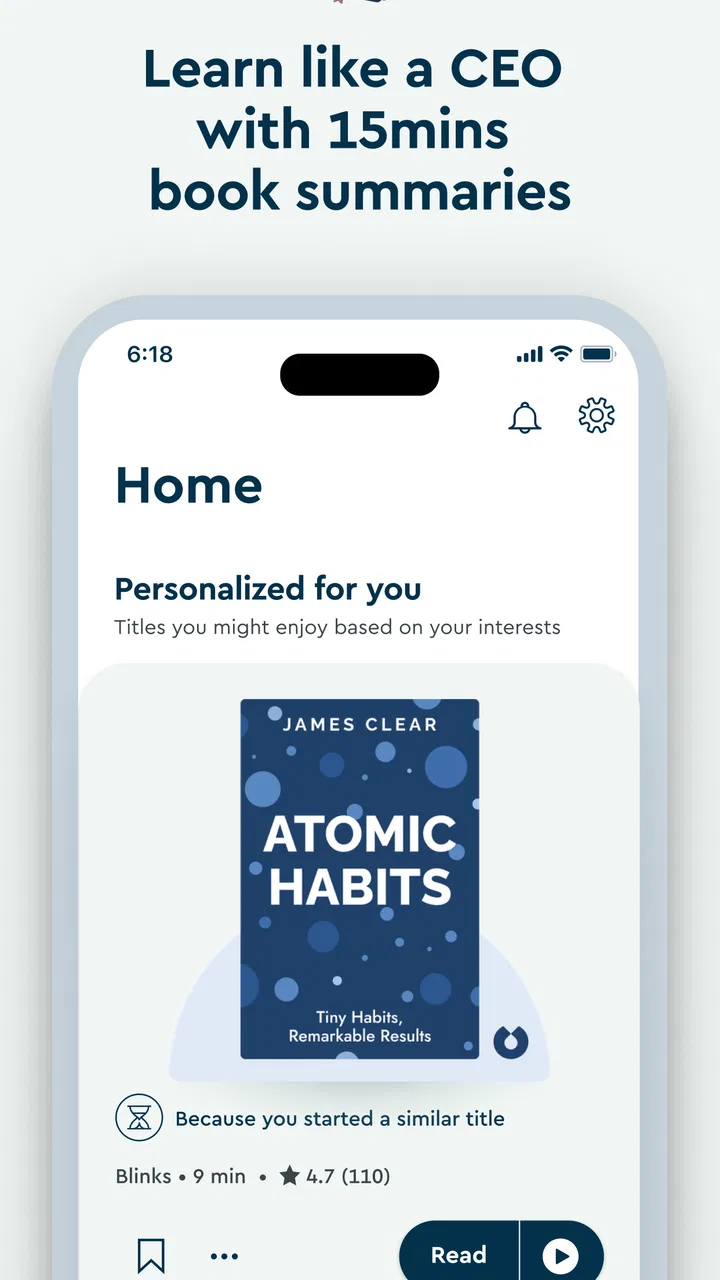
Blinkist is an app that offers concise summaries of non-fiction books, allowing users to grasp key insights in just 15 minutes. It features a library of over 5,000 titles across various categories. Users can read or listen to these summaries, making it ideal for those who want to learn quickly without committing to full books.
02Is Blinkist available on both Android and iOS?
Yes, Blinkist is available for both Android and iOS devices. You can download it from the Google Play Store for Android devices and the Apple App Store for iOS devices. The app ensures a seamless experience across all devices, allowing you to access your library anytime, anywhere.
03Does Blinkist offer a free trial or subscription plans?
Blinkist offers a free trial for new users to explore the app's features. After the trial period, users can choose from various subscription plans, including monthly and yearly options. Subscriptions provide unlimited access to the entire library, with both reading and audio features available.
04Can I use Blinkist offline?
Yes, Blinkist allows users to download summaries for offline access. This feature is particularly useful for those on the go or without reliable internet access. Simply download your chosen summaries while online, and you'll be able to read or listen to them anytime, even without an internet connection.
05How often are new book summaries added to Blinkist?
Blinkist adds new book summaries every week, ensuring a constantly updated library. This feature keeps users engaged with fresh content and allows them to stay informed about the latest non-fiction releases. The app covers a wide range of topics, from personal development to science and history.
Pros
- Extensive library of book summaries.
- High-quality audio narration available.
- User-friendly interface design.
- Offline access for reading on-the-go.
- Regularly updated with new titles.
Cons
- Limited to non-fiction titles only.
- Some summaries lack depth.
- Subscription cost may be high.
- No option for full book access.
- Requires internet for initial download.

Blinkist: Book Summaries Daily
Gallery